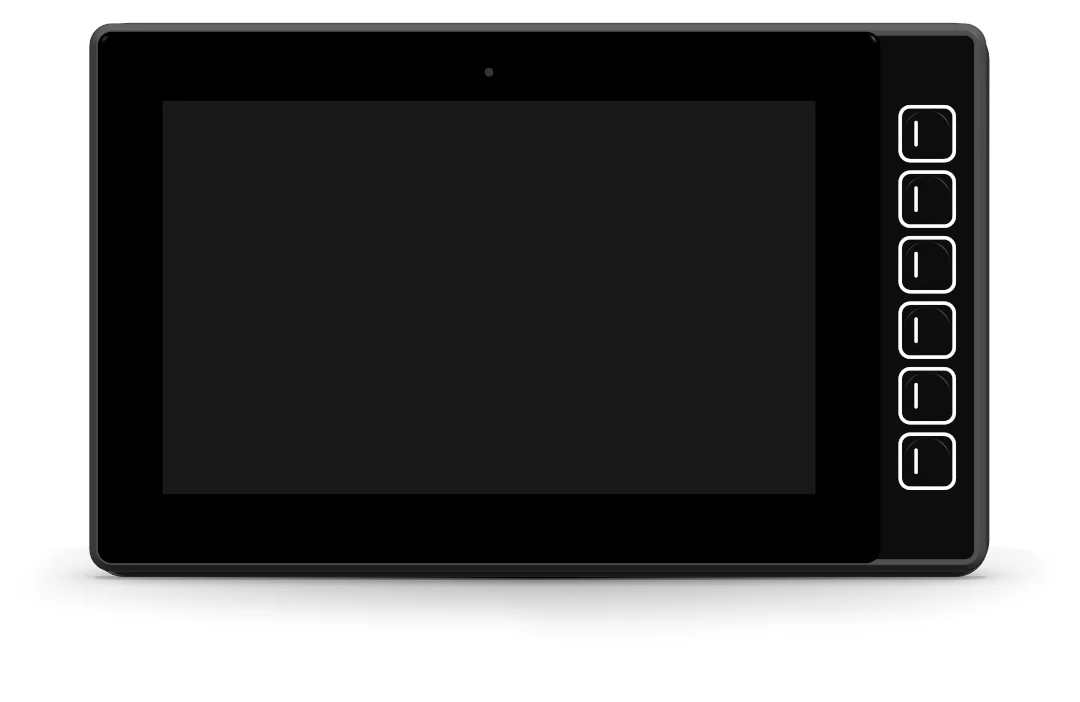
Highlights
- 7″ optically bonded TFT, 800 x 480 px
- 6 softkeys + capacitive touchscreen
- 2 x CAN: CANopen®, J1939, CAN Layer 2
- 9 … 36 V DC supply
- IP66 / IP67, -30 … +75 °C
- Deutsch DT06-08SA 8-pin connector
Programming
- OPUS Projektor 2024 or higher
- ISO UT (with ISOBUS UT plugin in OPUS Projektor)
- CODESYS (3.5 SP19 or higher)
- C++/Qt
- Operating system: Linux
Technical Specifications
| Display | |
|---|---|
| Display | 7″, 15:9 TFT, LED backlight |
| Resolution | 800 x 480 px |
| Brightness | typ. 850 cd/m² |
| Contrast ratio | 1000:1 |
| Optical bonding | Yes |
| User interface | 6 softkeys + capacitive touchscreen |
| Electronics | |
| Processor | NXP i.MX 6ULL, 32-bit ARM Cortex-A7, 528 MHz |
| Memory | 256 MB DDR3L RAM, 2 GB mass storage (4 GB eMMC in pSLC mode) |
| EEPROM | 8,192 bytes (7,424 bytes available for user) |
| Buzzer | typ. 90 dB(A) @ 10 cm |
| Power supply | 9 … 36 V DC, switched on/off via ignition (terminal 15) |
| Protection | Short circuit; over-voltage up to 48 V and inverse polarity up to -48 V (max. 5 min) |
| Current consumption (on) | 320 mA @ 13.5 V · 200 mA @ 27 V |
| Interfaces | |
| CAN | 2 x CAN, ISO 11898, CAN 2.0 B active, up to 1 Mbit/s (default 250 kbit/s), CAN-FD tolerant |
| Protocols | CANopen®, CANfreestyle (CAN Layer 2), J1939 |
| USB | 1 x USB 2.0, Type C, high-speed |
| RS232 | Only with service adapter |
| Connector | Deutsch DT06-08SA, 8 pin |
| Mechanical and environment | |
| Dimensions | 211 x 129 x 37.46 mm (excl. connector) |
| Weight | ~490 g |
| Housing | Glass, PC/ABS; landscape or portrait mounting |
| Operating temperature | -30 … +75 °C |
| Storage temperature | -40 … +85 °C |
| Ingress protection | IP66, IP67 |
| Mechanical | Shock, random and sinusoidal vibration: Level 2 |
| Certificates | CE mark, E1 type approval |
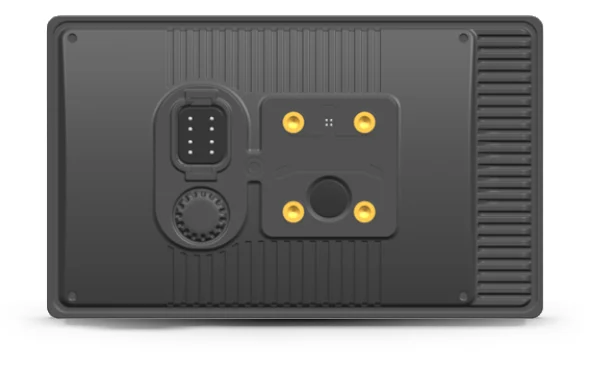
Rear view
Power modes and current consumption
The datasheet gives the maximum current values without external load for each power mode.
| Mode | 13.5 V | 27 V |
|---|---|---|
| On | 320 mA | 200 mA |
| Low power | 100-320 mA | 80-200 mA |
| Sleep | 70 mA | 70 mA |
| Off | ≤ 2 mA | ≤ 2 mA |
Connector pinout
The main connector of the device is the Deutsch DT06-08SA; the pinout is below.
| Pin | Signal | Description |
|---|---|---|
| 1 | SERV_EN | Service enable |
| 2 | KL15 | Ignition input (terminal 15) |
| 3 | KL31 | Supply voltage – (terminal 31) |
| 4 | KL30 | Supply voltage + (terminal 30) |
| 5 | CAN 2 L | CAN 2 low |
| 6 | CAN 2 H | CAN 2 high |
| 7 | CAN 1 L | CAN 1 low |
| 8 | CAN 1 H | CAN 1 high |
Additional interface and software information
- The CAN bit rate can be set to 250 (default), 500 or 750 kbit/s or 1 Mbit/s.
- According to the datasheet the video interface, Ethernet interface, extra inputs, extra outputs and audio interface are not available.
- The softkeys have a fluorescent print and no backlight.
- There is no real-time clock chip and no buffer; the system clock is kept only at runtime.
- Operating system: Linux kernel 6.0.0 or higher.
- In the datasheet the order numbers are split by programming environment: C++/Projektor, CODESYS and ISO-VT.
Environmental resistance
Examples from the tests listed in the datasheet:
| Temperature cycling | 30 cycles (each 8 h), between -30°C and +75°C |
| Temperature shock | 100 cycles (each 2 h), between -40°C and +85°C |
| Damp heat steady | 10 days at +40°C and 93 % r.H. |
| UV resistance | Overall time 1500 h |
| Drop test | From a height of 1 m onto a concrete floor, each side and each edge |
7″ and 4.3″ models compared
The 7″ model on this page shares the processor, memory and CAN interfaces with the OPUS B2s 4.3″ display with softkeys; the differences are display size, number of softkeys and current consumption.
| Feature | OPUS B2+s 7″ | OPUS B2s 4.3″ |
|---|---|---|
| Display / resolution | 7″ · 800 x 480 px | 4.3″ · 480 x 272 px |
| Softkeys | 6 | 4 |
| Brightness | typ. 850 cd/m² | typ. 800 cd/m² |
| Contrast ratio | 1000:1 | 800:1 |
| Current (on, 13.5 V) | 320 mA | 140 mA |
| Weight | ~490 g | ~260 g |
For all displays see the displays and HMIs category or the Topcon page.
TOPCON OPUS displays are supplied in the CODESYS version. We offer delivery from stock in Türkiye and local technical support.
DOWNLOADS
 OPUS B2+ Technical Data Sheet (PDF)
Frequently asked questions
Does the device have both softkeys and a touchscreen?
Yes. The device has 6 softkeys and a capacitive touchscreen; the keys have a fluorescent print and no backlight.
Does it have a camera input?
No. The datasheet lists the video interface, Ethernet interface and audio interface as not available. The interfaces are 2 x CAN, USB 2.0 Type C and RS232 with the service adapter only.
Which software environments can it be programmed with?
According to the specifications on this page, OPUS Projektor, the ISO UT plugin, CODESYS and C++/Qt can be used; the operating system is Linux kernel 6.0.0 or higher. In the datasheet the order numbers are listed as separate versions for C++/Projektor, CODESYS and ISO-VT; please tell us which environment you need.
Is the clock kept when the power is cut?
No. According to the datasheet there is no real-time clock chip and no buffer; the system clock is kept only at runtime.
Related service: our CODESYS application development service.