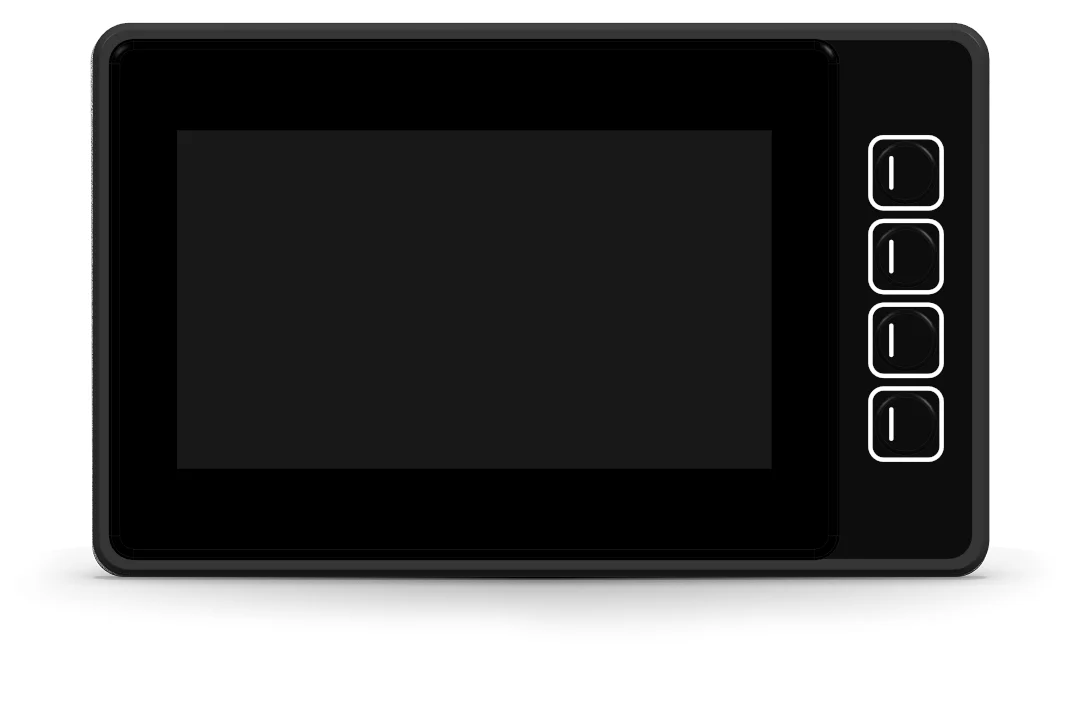
Highlights
- 4.3″ optically bonded TFT, 480 x 272 px
- 4 softkeys + capacitive touchscreen
- 2 x CAN: CANopen®, J1939, CAN Layer 2
- 9 … 36 V DC supply
- IP66 / IP67, -30 … +75 °C
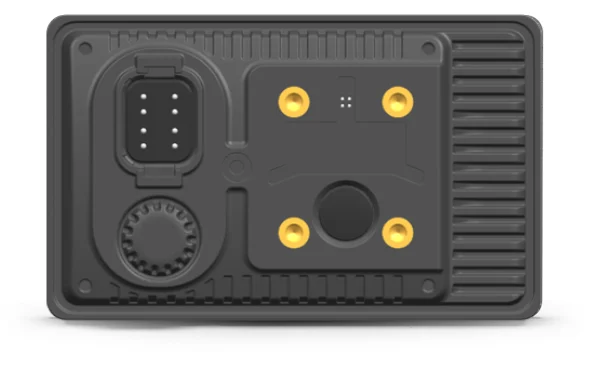
- Deutsch DT06-08SA 8-pin connector
Programming
- OPUS Projektor 2024 or higher
- ISO UT (with ISOBUS UT plugin in OPUS Projektor)
- CODESYS (3.5 SP19 or higher)
- C++/Qt
- Operating system: Linux
Technical Specifications
| Display | |
|---|---|
| Display | 4.3″, 15:9 TFT, LED backlight |
| Resolution | 480 x 272 px |
| Brightness | typ. 800 cd/m² |
| Contrast ratio | 800:1 |
| Optical bonding | Yes |
| User interface | 4 softkeys + capacitive touchscreen |
| Electronics | |
| Processor | NXP i.MX 6ULL, 32-bit ARM Cortex-A7, 528 MHz |
| Memory | 256 MB DDR3L RAM, 2 GB mass storage (4 GB eMMC in pSLC mode) |
| EEPROM | 8,192 bytes (7,424 bytes available for user) |
| Buzzer | typ. 90 dB(A) @ 10 cm |
| Power supply | 9 … 36 V DC, switched on/off via ignition (terminal 15) |
| Protection | Short circuit; over-voltage up to 48 V and inverse polarity up to -48 V (max. 5 min) |
| Current consumption (on) | 140 mA @ 13.5 V · 110 mA @ 27 V |
| Interfaces | |
| CAN | 2 x CAN, ISO 11898, CAN 2.0 B active, up to 1 Mbit/s (default 250 kbit/s), CAN-FD tolerant |
| Protocols | CANopen®, CANfreestyle (CAN Layer 2), J1939 |
| USB | 1 x USB 2.0, Type C, high-speed |
| RS232 | Only with service adapter |
| Connector | Deutsch DT06-08SA, 8 pin |
| Mechanical and environment | |
| Dimensions | ~144 x 89 x 35 mm (excl. connector) |
| Weight | ~260 g |
| Housing | Glass, PC/ABS; landscape or portrait mounting |
| Operating temperature | -30 … +75 °C |
| Storage temperature | -40 … +85 °C |
| Ingress protection | IP66, IP67 |
| Mechanical | Shock, random and sinusoidal vibration: Level 2 |
| Certificates | CE mark, E1 type approval |
Rear view
DOWNLOADS
 OPUS B2 Technical Data Sheet (PDF)
Request a quotation or technical information for this product — Contact us →